Wednesday, August 21, 2013

Getting to know your characters

This is that awkward phase of finishing the novel in progress, but characters are calling out to me for the next one. "Schumaker" (which title will be improved upon before it is released) is going to the editor the first week of October. I will continue to fix the issues until that point (and yes, there are still issues).  I'll keep you posted.

BUT

While I'm taking that deep breath that says, "I'm almost done, I need to recover from the effort it takes to complete this project," I can't get the new characters to be quiet. Amend that. They aren't all new characters. Returning for the next novel will be Cinda Cooper, Audrey's best friend in Living Canvas. To tie this all together, maybe you didn't know that Greg in Living Canvas is Kira's brother from Touched by the Sun (The Treasure of St. Paul).

Cinda's character was greatly impugned during the reading/writing of Living Canvas and she has been stomping around inside my head telling me she wants her say. She doesn't think people understand her. So I sat down and outlined her story.
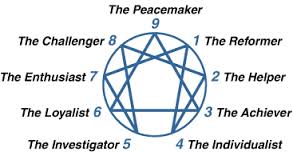
There is a psychological personality profile, or enneagram, that helps people - business people, writers, and whoever else has a need to profile personalities - to understand what makes people tick. In anticipation of not missing some of Cinda's finer qualities, I ran an enneagram on her. It's pretty much what I expected, but it helps me to know more about her background and the way she responds under stress or in a positive situation. As I ran it, I realized I'd gone through this process before, when I first started writing Living Canvas years ago.

Most characters are fairly straight "reads." You know them like you know your best friends. You know what makes them tick, what makes them shrink, what makes them grow. Some characters aren't quite so straightforward. Cinda never was.

I read a book recently by Susan Elizabeth Phillips with an alpha female character, one who was so very unlikeable and one the reader has to find a way to like. SEP is very good at writing her characters that way. Make them the most godawful people that ever walked the earth, and make your readers root for them by the end of the novel. Cinda might not be quite that awful, but she ranks up there with disagreeable, manipulative, meddling people. My personality doesn't blend well with that type, so I don't have a "friend" to base her on. Hence, the enneagram. I can tell you that she was much nastier in the original drafts of Living Canvas. Much less likeable than she ended up (much to the amazement of those of you who have voiced your dislike of her as she appeared). During the writing process, I got to know her better. And that's why, when she insisted I show people "the real Cinda," I felt I had no choice.

I'm hoping to take a page out of the SEP writing handbook. A touch of humor helps defend an unlikeable character. Some sympathy for the devil (maybe that's the working title?!).  Hopefully when I'm done, she won't appear quite the devil she seems.

Wednesday, August 14, 2013

Nominees for Favorite Author

So many to choose from!  This topic came to mind when I saw that one of the authors I favored while growing up died recently.

I discovered Barbara Metz, aka Barbara Michaels, aka Elizabeth Peters via a made for TV movie (The House that Would Not Die). Campy, Aaron Spelling, I believe, but it was a haunted house movie and I loved those! The book was titled Ammie Come Home. Barbara Michaels is a bit of an acquired taste - I like the supernatural infusion into the story, although her romances are a bit bland. Almost nonexistent. Upon her death, I've begun reading some of the Elizabeth Peters novels, which are more centered around Egyptology. Another subject I enjoy. Am I going to stand on my soapbox and proclaim her the best author ever? No. But I do enjoy her books. They'd probably appeal more to a YA audience than a romance audience, and they are dated. Her "romance" subplots are grossly understated (to the point of almost nonexistent).

Another of my favorites is Victoria Holt. Gothic romances that I keep on my shelves to read and reread. But those are the "oldy moldies" among my collection.

In more "modern" times, I've acquired a taste for Teresa Medeiros and Mary Balogh in the romance venue. I also enjoy Dan Brown and John Grisham. Stephen King continues to horrify and delight me.

And then one must take into consideration categories. Classics? Current bestsellers? Old standbys? What makes an author a "favorite?" There are so many choices these days, and my short list doesn't begin to encompass all the books that have touched me in one way or another. The authors I've listed are the "brands" that I know and love and trust.  There are countless books that I've enjoyed, but that wouldn't necessarily put the author on my "favorites" list. To achieve that status, I look for consistency.

The Harry Potter books are consistent. But would I put J.K. Rowling on my favorite author list? I'm not sure. I haven't read her other stories. Likewise, I'm not going to beat a dead horse and discuss another author whose first two books literally changed my life. Made me want to live inside the pages of a book. Sent me off on an adventure to find something that didn't exist. And yet, that author does not rank among my favorites (because of the lack of consistency). I suppose that translates to Favorite Books and Favorite Authors not always in harmony with each other.

When you think of your favorite author, do you think of something you've read more recently, or something that you have on your shelf that you will go to again and again (that might be more "dated")? An author who is still productive today, or who is pushing up daisies? An "old friend" or a recent discovery?

Wednesday, August 7, 2013

Where do you go for vacation?

Every year, I try to make it a point to "get away from it all" for at least a few hours at a time. Whether it's day trips to local parks and attractions, a day in the "Big City," or a plane ride somewhere far away.  This year, we're doing home improvements. Not much of a vacation, but the budget only covers so much, doncha know.

I've resigned myself to the fact that I'm not going anywhere this year. We had a "big trip" last year, but even DH is wishing for a little getaway while he struggles through demolition stages prior to rebuilding. We'll probably manage a weekend away somewhere - probably within driving distance.

What kind of vacations do you like? Cities? Mountains? Beaches? The desert? National Parks? Museums? We've done all of these, and I have to say that at different times, all of them have their appeal. I enjoy quiet nights, gazing out over the ocean/lake, but I'm done after a day or two at the beach. Cities have their appeal as well, but again, not on the top of my list. Conversely, DH is done after a day or two hiking across the desert or through the mountains, although he enjoys taking pictures at the national parks. We generally try to diversify our trips so that I have my "middle of nowhere" places and he gets his "bustle of the city" places. Last year's trip took us to major cities as well as out of the way villages. Me? I'm writing a story about one of the places we stopped (that small village feel) that made my favorite places list, and him? He wants to go back to the bustling city. So much to see and we didn't get nearly enough time there. I agree, but I'd still go back to my small village first.

It's all about compromise in the end. I did enjoy that bustling city (although I have to say he wasn't as impressed with my little village). Different strokes, and all that sort of thing. DH is an engineer. He has an analytical mind that is stimulated by trying to figure out how things work. Seeing engineering marvels and architectural anomalies. Me? I'm the romantic. I can appreciate his views and find all those things interesting, but I'm more captivated with a perfect setting. Rolling hills, brilliant colors, unusual rock formations, flora and fauna, glittering waterfalls. Things man can't recreate. God's thumbprints from where he's shaped and sculpted the world.

A few years ago, we went to Las Vegas and Utah and Arizona. The first part of the trip was to Bryce Canyon. The colors and the rock formations took my breath away. For me, it was more intimate than the Grand Canyon. I loved it.  DH loved the photo ops, but got tired of it pretty quickly. We went to Page, Arizona, to Antelope Canyon (which is so much of a tourist trap, and yet is so highly unique that I'd still recommend it), and DH was equally impressed with the construction of the bridge across Lake Powell as with the natural landscape. When we left for Vegas, he was anxious to be back to civilization and all the glitter and architecture that makes that city so unique. While I can appreciate the singular appeal, as we drove through the desert, closer to the city, when DH tried to appeal to my sense of "wow," I'd already been wowed by the canyons.  I simply smiled and said to him, "you didn't complain for my part of the trip, so I won't complain for your part." Don't get me wrong, we both enjoyed everything we saw. It's a matter of measure. How many canyons can you see before you go "eh?" and How many casinos can you walk through before you are overwhelmed?  It was a great trip all around.

Where do you go to get away from it all? To the urban jungle? Or to the far reaches of civilization?

Wednesday, July 31, 2013

The Fine Art of Procrastination

Yes, I've finally typed "The End" on my Schumaker story, but this is where the real work comes in. Cleaning up the mess of hastily scribbled words. Shouldn't be so hard, you say?

My first drafts are generally very scattered and confusing. In my head, they make perfect sense. On paper, a reader would look at some of this and say "where did that come from?" That's what I'm addressing now. Those disconnects. The information that isn't "on the page." And the structural end of it. It's an end to the imagination part and the start of the work part.

This is what a writing day looks like:

Sit down at computer. Power it up. Get something to drink while said computer "wakes up." Sit down again. Open work in progress. Read the previous chapter (or, the spot I've bookmarked to go back to). Switch to Facebook. Check posts. Switch to Twitter. Check Tweets. IM friends.

Oh. WAIT! I'm supposed to be writing. 

Close Facebook. Close Twitter. Give friends the "TTYL."

Re-read work in progress.

Switch to Bejeweled Blitz and achieve the next keystone. Switch to Candy Crush and use up five lives.

WAIT! I'm supposed to be working.

Switch back to work in progress. Oh. It's lunchtime, and I have to go to the grocery store.

Come back from lunch. Sit at computer and open work in progress. Point finger at self and repeat after me, "You will get this done." Focus on work in progress.

I'm on a roll now. New chapters. Crutch words dumped. Useless phrases deleted. Cross reference copyediting done. 

Guess what?  Now it's dinner time. And, believe it or not, I've accomplished something!

Some days, procrastination isn't a problem. Laser-like focus is right there from the minute I sit down. But on those wool-gathering, butterfly chasing days, it takes a little longer to get down to the business of writing. The take-home message here is to get to it. Even if you find yourself wandering off task, it's important to get "something" done. Books don't write themselves.

Some authors set goals for themselves. "X" amount of words per day, or "X" number of hours per day. Goals are a good way to hold yourself accountable. For me, throwing in a work day (and sometimes very unpredictable work days) makes those types of goals a little more challenging. The most important part of writing is writing. Make the time. Limit distractions.

I have to get back to editing now.

I wonder if those airfares have come down so I can plan my vacation yet?

Wednesday, July 24, 2013

His Royal Babyness

Congratulations to Prince William and Duchess Catherine on the arrival of their new son and heir.

British royalty has been a tradition and a mainstay for centuries, and even now, when the Queen is little more than a figurehead, it is one of the last remnants of a privileged society. The last several decades have had a major impact on the royal family - a positive impact, I believe. There comes a time when tradition has to bow to the times. Always a difficult transition. As a romance author and a reader of historical novels, it is easy to imagine the struggles of the royals even when we have no clue about what really happens behind closed doors.

Prince Charles has led a colorful life. Looking back at the years before he married Diana Spencer, he didn't seem very interested in settling down to live the life of a king. Can't you just imagine HRH Queen Elizabeth wagging her finger at him and threatening him that he'd never be king until he got his act together and did what was expected of him? And so a bride was selected for him. Just like in a romance novel. An arranged marriage, or so it would seem.

I will tell you that I have no idea about the inner workings of the royal family, so my waxing poetic today has no basis in actual fact. I do know that the world fell in love with Lady Diana, and she produced two fine heirs to the throne. That Charles and Diana changed the course of royal history goes without saying. One thinks back to Edward and Wallis Simpson and the scandal of that era, and the changes the world has gone through to where it was now acceptable for the heir to the throne of England to divorce his wife and not lose his line of succession (although that has yet to be determined).

Speculation is that William will step over his father as Charles advances in years and the Queen appears to want to live forever. William has set other precedents. First, he married a "commoner." The pool of "acceptable royalty" has dwindled considerably. The royal family has become more accessible, and now the world watches to ensure the success of the young royals. And then, of course, there is the change in the rules of royal succession (which have been rendered unnecessary in this generation). It is now acceptable for a firstborn daughter to take the throne as queen rather than a secondborn son to ascend before her.

I heard on the radio this morning that if William lived to be 80, his son wouldn't take the throne until 2062 (or some such far distant year). One wonders about the world changes that might alter the course of future events. Will the royalty continue as a British tradition? Or will they be rendered an unnecessary government expense?

In the meantime, a whole new generation of young girls can sing along with "Some Day My Prince Will Come," and actually cling to the possibility that they have a chance with the new Royal. After all, if his father could marry someone outside of his class, it stands to reason the young Prince will follow suit.

It's the stuff romance novels are made of - new doors to open, new possibilities, new dreams, and the hope of happily ever after.

Wednesday, July 17, 2013

Series Books - Pitfalls and Pratfalls

I'm gleefully editing my "Schumaker" story. Still enjoying it, in spite of the fact that I'm now into the "work" end of it rather than the less structured, creative aspects. In spite of the fact I've read this story a dozen times already.

As I work out the kinks and clean up the sloppy bits, my mind is racing ahead to the next story (although I can only write one at a time). I've been making notes for Cinda's story (from Living Canvas), but I'm also concerned about writing the second Kundigerin story (Wolf's story), and that concern is reinforced by some feedback I received.

The thing about writing a series (Kundigerin is my first "series") is that you have to leave room to expand on a theme. Provide information to the reader to draw them into subsequent books. In Mist on the Meadow, we find out that Wolf has a gift of his own which is unexplained. And there is a scene in the book which the characters don't quite understand (and that is conveyed, they don't know exactly what happened). Consider those points "teasers" for the next book. The plot is resolved, the relationship is resolved, but some of the more ambiguous points remain so, to be addressed in the next book. I'm pleased that people #1) notice these points, and #2) aren't getting hung up on them to the point where they didn't like this story. It's a delicate balance that I'm still learning.


Part of me feels I should continue Wolf's story before I do Cinda's - and this is the problem with an active imagination. So many ideas! So little time. I didn't immediately embark on Wolf's story after finishing Mist on the Meadow because there is a "recovery" period after you write a story. Finishing a book is like childbirth (you may have heard that analogy). I was exhausted with Wolf and Marissa - needed some time away from them. I had Schumaker on my mind, so I delved into it head-on.

I think of Anne Rice and her Vampire books. I remember reading them when they were "new." She annoyed me with her "open" endings. I like my books, even in a series, to have a beginning, a middle and an end. Anne Rice didn't give me an end. I finished The Vampire Lestat with a gasp, and Queen of the Damned had not yet been released. I was angry! I wanted to know what happened! I'm a little worried that some people will feel that way with Mist on the Meadow. It isn't open ended, but some things are unresolved, to be continued. I owe it to my readers to answer their questions!

And yet Cinda is whispering in my ear.

The final decision will come when I finish "Schumaker" - and I'm getting closer! By that time, Cinda may have quieted down and I won't be so conflicted. I do feel a responsibility to Wolf, after all. And I am chomping at the bit to take a tour of the Schwarzwald. The Kundigerin series is still active in my imagination and seeing some of the "old country" will surely help me perpetuate the folklore I've created. Unfortunately, the trip will probably have to wait until I get to Kundigerin 3 (Uncle Balt and Rosalie). Keeping my fingers crossed (and anyone who wants to share their experiences in that region - The Black Forest, I'd love to hear from you!)


Wednesday, July 10, 2013

Titles - or How to Summarize a Book in Four Words or Less

I am finishing up the first draft of my next novel, which began with an inspiration from the Grimm’s Fairy Tale of “The Shoemaker and the Elves.” Yes, well, it isn’t anything like that story, really, even though my working title is "Schumaker and The Elf Writer."

From the time Michelle’s father left to serve his country and never returned, Michelle has grown used to men leaving her, and her attractive new tenant is no exception. In spite of their initial attraction, she is determined not to become involved with a man she knows up-front will leave her. But her long-lost father has something to say about that . . .

Author Keith Schumaker is renting a home near the hospice where his mother lays dying while he finishes his latest novel. His agent assigns a ghostwriter to him to get him to “the end,” a ghostwriter who, unbeknownst to Keith, is also his landlord.

Michelle Alvere donates an egg to help her sister conceive, but her sister refuses to help Michelle recuperate after complications from the procedure send Michelle into surgery. Michelle rents out her home and runs away to the South of France to visit an aunt until the baby's due date, but the author renting her house back home isn’t ready to vacate. 

If you're wondering where I came up with "The Elf Writer," based on the "Shoemaker and the Elves," I picked Michelle's surname to represent something Elfin. Alvere, in French, translates to Elf Counsel. As a ghostwriter, that's kinda sorta what she does . . .

Any title suggestions?